
Post-Quantum Computing Lab
Welcome to the Future of Cryptography
Modern cryptography addresses four key objectives:
Confidentiality:
Ensures information is accessible only to the intended recipient.
Integrity:
Guarantees that the information is not altered during storage or transit.
Non-Repudiation:
Prevents the sender from denying they sent a message.
Authentication:
Confirms the identity of the sender and receiver.
Confidentiality:
Ensures information is accessible only to the intended recipient.
Integrity:
Guarantees that the information is not altered during storage or transit.
Non-Repudiation:
Prevents the sender from denying they sent a message.
Authentication:
Confirms the identity of the sender and receiver.
Post-Quantum Cryptography:
Post-Quantum Cryptography (PQC) focuses on developing cryptographic techniques that are secure against potential future attacks from quantum computers. Quantum computers can break traditional cryptography by using advanced algorithms that can solve complex mathematical problems much faster than classical computers. This capability threatens the security of widely used encryption methods, which rely on the difficulty of these problems to keep information safe. As quantum computing advances, traditional encryption methods like RSA and ECC may become vulnerable. PQC aims to create robust algorithms that ensure secure communication even in a post-quantum world.

NIST Finalizes Post-Quantum Encryption Algorithms
The U.S. Department of Commerce’s National Institute of Standards and Technology (NIST) has selected the first group of quantum-resistant encryption tools to secure sensitive data against potential future attacks from quantum computers. This announcement marks a significant milestone in establishing a post-quantum cryptographic standard, expected to be finalized in about two years.
Digital Signature Algorithms (DSA):
Key Encapsulation Mechanisms (KEM):
Projects
Description:
KyberLite – A Baby Kyber Accelerator focuses on developing a simplified version of the CRYSTALS-Kyber algorithm, emphasizing Post-Quantum Cryptography (PQC) principles. By implementing core cryptographic operations such as key generation, encryption, and decryption, KyberLite aims to provide an accessible platform for understanding and experimenting with quantum-resistant cryptographic techniques.
Mentor:
Dr. Farhan Ahmed Karim and Shahzaib Kashif
Description:
Athestia is a project focused on enhancing internet security by combining Named Data Networking (NDN) with the post-quantum cryptographic algorithm Dilithium at security level 5. It integrates Dilithium’s quantum-resistant digital signatures with NDN’s data-centric model to ensure secure and efficient communication. By developing a Dilithium accelerator for key generation, signing, and verification, Athestia improves data access speed, reduces server load, and provides a future-proof solution for secure digital communications.
Mentor:
Dr. Farhan Ahmed Karim
Description:
KyberQuanta is a quantum-resistant hardware accelerator designed to secure communication using the CRYSTALS-Kyber 768-90 algorithm, offering security equivalent to AES-192. Built on an FPGA, KyberQuanta ensures efficient key exchange and encryption, making it ideal for protecting against future quantum computing threats. Integrated with the EnigmaChat platform, it provides a reliable and secure messaging environment, with a central server managing public key distribution and communication between users.
Mentor:
Dr. Farhan Ahmed Karim
Description:
KyberLite – A Baby Kyber Accelerator focuses on developing a simplified version of the CRYSTALS-Kyber algorithm, emphasizing Post-Quantum Cryptography (PQC) principles. By implementing core cryptographic operations such as key generation, encryption, and decryption, KyberLite aims to provide an accessible platform for understanding and experimenting with quantum-resistant cryptographic techniques.
Mentor:
Dr. Farhan Ahmed Karim and Shahzaib Kashif
Description:
Athestia is a project focused on enhancing internet security by combining Named Data Networking (NDN) with the post-quantum cryptographic algorithm Dilithium at security level 5. It integrates Dilithium’s quantum-resistant digital signatures with NDN’s data-centric model to ensure secure and efficient communication. By developing a Dilithium accelerator for key generation, signing, and verification, Athestia improves data access speed, reduces server load, and provides a future-proof solution for secure digital communications.
Mentor:
Dr. Farhan Ahmed Karim
Description:
KyberQuanta is a quantum-resistant hardware accelerator designed to secure communication using the CRYSTALS-Kyber 768-90 algorithm, offering security equivalent to AES-192. Built on an FPGA, KyberQuanta ensures efficient key exchange and encryption, making it ideal for protecting against future quantum computing threats. Integrated with the EnigmaChat platform, it provides a reliable and secure messaging environment, with a central server managing public key distribution and communication
between users.
Mentor:
Dr. Farhan Ahmed Karim
Achievements:
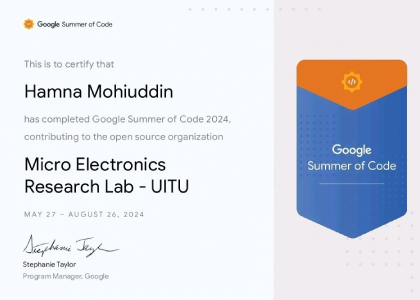
Our team member, Hamna Mohiuddin, successfully secured a Google Summer of Code 2024 project titled “Kyber-Lite – A Baby Kyber Accelerator”. This project focuses on developing a lightweight, hardware-accelerated implementation of the Kyber algorithm, enhancing post- quantum cryptographic security.